Discovery Investigations – 100 Years Of Marine Science Stamp Release
December 18, 2025
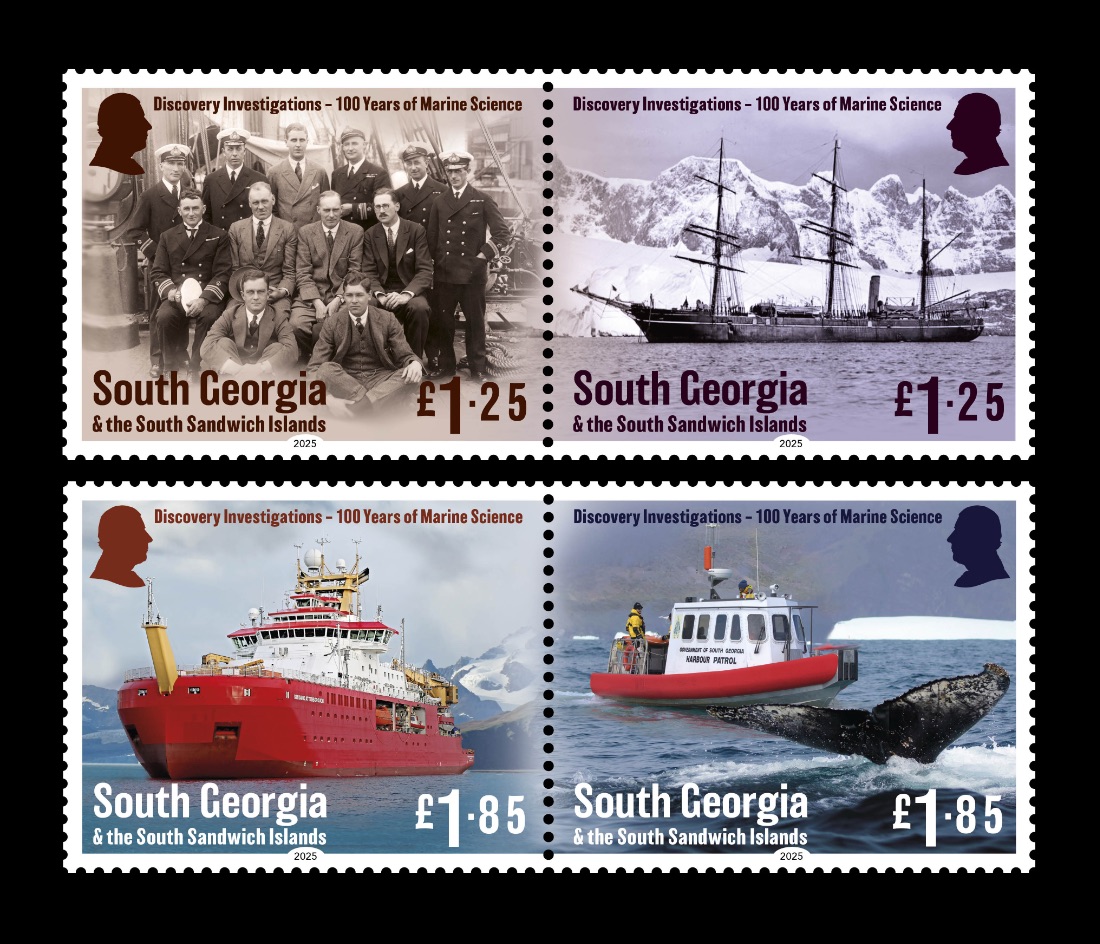
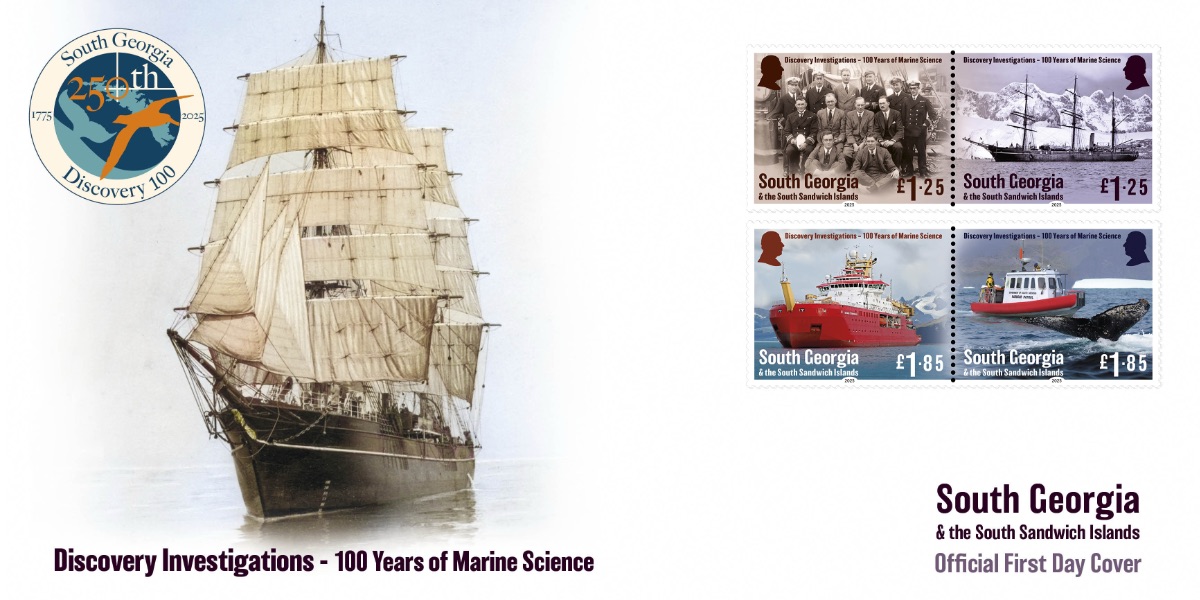
Today, the Government of South Georgia & the South Sandwich Islands (GSGSSI) is delighted to release a stamp set to commemorate the Discovery Investigations.
Two-hundred and fifty years ago Captain James Cook landed at Possession Bay and took possession of South Georgia, in the name of King George III and his heirs. In this anniversary year we celebrate South Georgia and its change from a little known and little valued island to a thriving UK Overseas Territory which is globally renowned for championing science, conservation and sustainable management. Each set of stamps will focus on a different element of South Georgia and shine a light on both its history and its future.
This fifth and final issue focuses on the centenary of the establishment of the Discovery Investigations and its legacy of world class marine science.
During the early part of the 20th century, the whaling industry in South Georgia was expanding rapidly and led to a steep decline in whale stocks. At the time, whales were viewed as a valuable commercial asset, and the Discovery Committee was formed to gather scientific data needed to understand and manage whale stocks sustainably. In 1925, this led to the first of the Discovery Investigations.
A shore-based ‘marine laboratory’ named Discovery House was established at King Edward Point. Scientists at the laboratory worked closely with the whalers at the nearby Grytviken station and were able to dissect and collect data from thousands of whale carcasses that were brought ashore for processing.
In parallel with the shore-based research, the RRS Discovery, which had previously been used by Captain Robert Falcon Scott CVO for his famous Antarctic expedition, was re-fitted for use in oceanographic research. The crew of RRS Discovery collected oceanographic data, undertook bathymetric surveys and studied krill, the primary food source of many whale species. The investigations were later joined by other research vessels, including the RRS William Scoresby and the RRS Discovery II (from 1929) which carried out thousands of observations at sea.
Data from the shore station and the various research vessels were compiled into the Discovery Reports. This 38 volume set is considered the foundational reference for Southern Ocean marine biology. Furthermore, the Discovery Investigations provided key evidence demonstrating that a number of whale species were being driven to extinction and ultimately led to the international moratorium on commercial whaling declared in 1982.
The legacy of the Discovery Investigations endures and much of the biological oceanography and marine ecosystem science which happens today is built on the foundation of information gathered during that time. Research continues to monitor the recovery of whale populations after the ban on commercial whaling and the British Antarctic Survey leads a number of projects studying the distribution, health, and population dynamics of whale species. Recent research tracking whale occurrence, in relation to shipping traffic, fisheries and climate change has led to important new conservation measures, to limit the impact of human activities such as noise and collision risk. Other research has focused on measuring krill consumption and assessing krill stocks to ensure they are sufficient to sustain the recovering whale population and has contributed to the design and monitoring of the South Georgia & the South Sandwich Island’s extensive Marine Protected Area.
A testament to the long-term research efforts is that whale populations around South Georgia are in recovery, with species such as the humpback whale estimated to be at over 90% of their pre-whaling population. For other species, such as the Antarctic blue whale, southern right and fin whales, whilst there are encouraging signs, the levels of recovery are lower. Research is ongoing into the possible reasons for this and include the theory that whale distributions have shifted since whaling perhaps to track a southward shift in krill concentrations.
The stamps are available to purchase through www.falklandstamps.com or for trade customers via www.iomstamps.com.