Blue Belt Programme: 10th Anniversary: Stamp Release
October 13, 2026
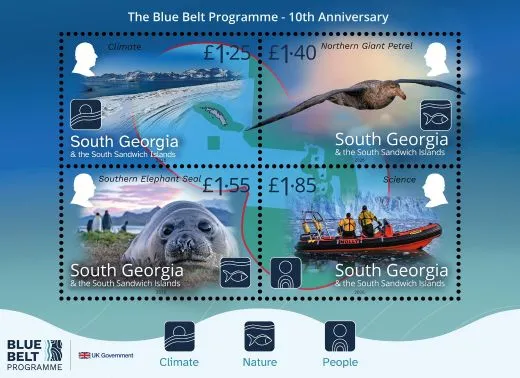
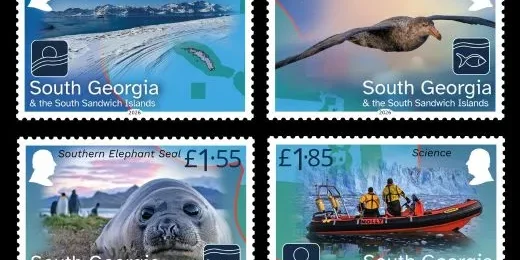
In celebration of the 10th anniversary of the Blue Belt Programme, the Government of South Georgia & the South Sandwich Islands on the 9th of September 2026 have released a special commemorative stamp issue which includes stamps, a sheetlet, and corresponding first day covers.
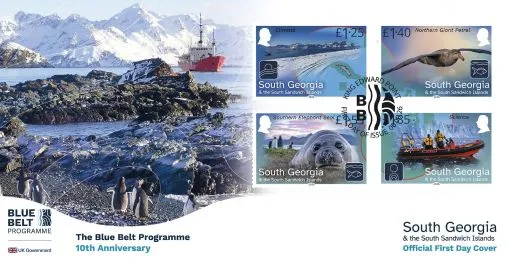
The UK Overseas Territories (OTs) are home to 90% of the UK’s biodiversity. Since its launch in 2016, the UK Blue Belt Programme has worked in partnership with Territory Governments to enhance the protection and sustainable management of these unique marine environments, marking a decade of collaborative ocean stewardship. In total, 4,309,000 km2 of the world’s oceans are protected by the Blue Belt Programme. That is an area 18 times the size of the UK.
Operating in some of the most remote and biologically rich regions on Earth, the Programme brings together science, monitoring, compliance and capacity building to support long-term ocean management. Through this partnership approach, it has helped establish and strengthen large-scale Marine Protected Areas (MPAs), improve fisheries sustainability, and develop the evidence base needed for adaptive, ecosystem-based management. This work reflects a shared commitment to safeguarding marine ecosystems while supporting sustainable use for future generations.
Over the past ten years, the Blue Belt Programme has continued to evolve, strengthening its focus through three key pillars: climate, nature and people. Together, these priorities support the protection of marine ecosystems, improve resilience to environmental change, and ensure that science and management underpin sustainable use of the ocean. This work continues to be supported by leading UK delivery partners, including the Centre for Environment, Fisheries and Aquaculture Science (Cefas) and the Marine Management Organisation (MMO).
The South Georgia and South Sandwich Islands Marine Protected Area (SGSSI MPA), one of the largest in the world at 1.24 million km2, is home to some of the planets most biologically rich marine ecosystems. Established in 2012 and strengthened through regular review, the MPA was further enhanced in 2025 with a major expansion of No Take Zones, now covering over 470,000 km2, alongside additional closures that ensure krill fishing is now prohibited across more than half a million km2.
Supporting a highly productive and biodiverse Southern Ocean ecosystem, the SSSI MPA sustains species from plankton to whales and serves as a natural laboratory for climate research. Evidence-based management, including a complete ban on bottom trawling, extensive No-Take Zones and strictly regulated, MSC certified sustainable fisheries. ensure this is one of the most effectively protected
ecosystems globally.
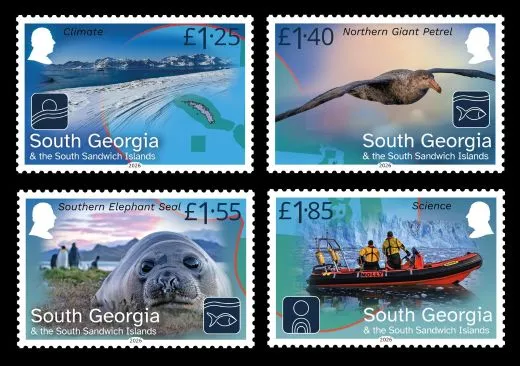
These stamps celebrate the Blue Belt Programmes three pillars through examples from South Georgia and the South Sandwich Islands.
£1.25 – Climate: Glacier
Glaciers are a defining feature of South Georgia’s landscape and are highly sensitive indicators of climate change. Rapid glacial retreat across the island reflects wider warming trends in the Southern Ocean, influencing freshwater input, coastal habitats and ocean circulation. Monitoring these changes helps improve understanding of how climate-driven processes affect marine ecosystems and the species that depend upon them.
£1.40 – Nature: Northern Giant Petrel
The northern giant petrel is a wide-ranging pelagic bird and an important higher predator within the Southern Ocean ecosystem. Breeding at South Georgia in significant numbers, these birds play a key ecological role in nutrient cycling and food web dynamics. Long-term monitoring of their populations provides valuable insight into ecosystem health and the availability of prey species.
£1.55 – Nature: Southern Elephant Seal
South Georgia supports one of the largest breeding populations of southern elephant seals globally. They are important consumers of fish and squid, undertaking long foraging migrations across the Southern Ocean. As top predators, their population trends and foraging behaviour may act as key indicators of changes in the marine environment, particularly in relation to prey availability and climate variability.
£1.85 – People: Science at King Edward Point
Scientific research is critical to the effective management of the SGSSI MPA. At King Edward Point, scientists from the British Antarctic Survey (BAS) conduct long-term monitoring and research programmes that underpin evidence-based decision making. This work includes studying predator populations, tracking ecosystem change, and assessing the potential impacts of fisheries and climate change, ensuring that management measures remain robust and adaptive.
The sheetlet and first day cover are available to purchase through www.falklandstamps.com or for trade customers via www.iomstamps.com.